




If you are developing an aluminum e-bike frame, two alloy names appear again and again: 6061 aluminum and 7005 aluminum.
At first glance, choosing between them seems simple. 7005 has higher raw tensile strength, while 6061 is widely used throughout the bicycle industry. That often leads to a basic question:
Is 7005 automatically better than 6061 for an e-bike frame?
The short answer is no.
7005 generally offers somewhat higher mechanical strength in comparable tempers, but 6061 provides an excellent combination of strength, formability, weldability, corrosion resistance, tube-shaping capability, availability, and manufacturing consistency. For modern e-bikes—especially frames requiring complex motor mounts, integrated batteries, hydroformed tubes, and full-suspension structures—6061 is actually an extremely practical choice.
More importantly, the alloy number does not decide whether an e-bike frame is strong, light, or durable.
A properly engineered 6061 aluminum e-bike frame can outperform a poorly designed 7005 frame because the finished product depends on much more than base-metal strength.
Frame geometry, tube diameter, wall thickness, welding quality, heat treatment, suspension layout, motor integration, battery placement, reinforcement strategy, and fatigue testing all play equal major roles.
This guide compares 6061 vs 7005 aluminum bike frames from an engineering and manufacturing perspective to help bicycle brands, product managers, distributors, and OEM buyers to make a more informed decision.
6061 vs 7005 Aluminum: The Quick Answer
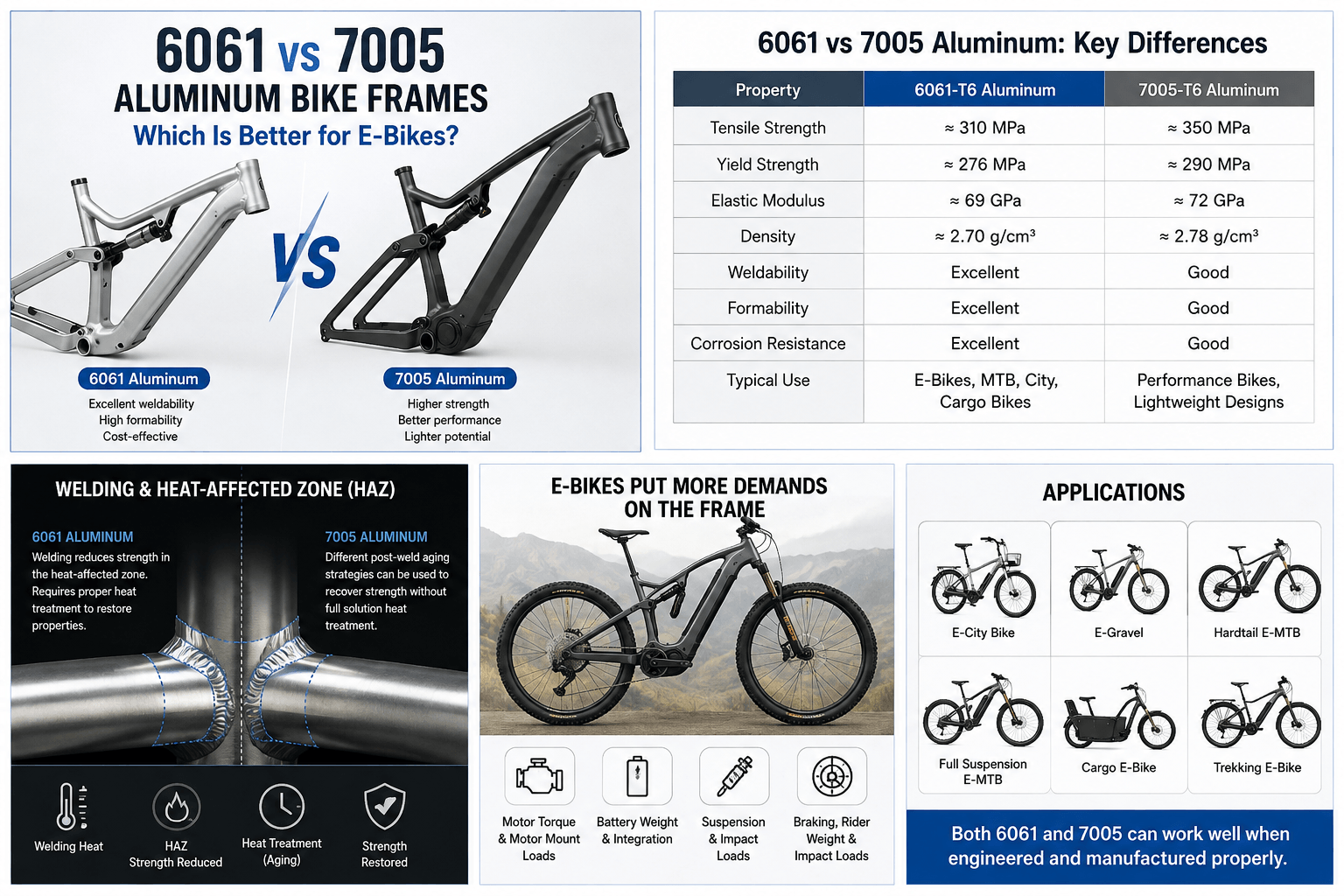
For most modern e-bike applications, 6061 aluminum is often the more practical all-around choice, while 7005 can be attractive when a design specifically benefits from its higher base-material strength and manufacturing characteristics.
Here is the simplest comparison:
Factor | 6061-T6 Aluminum | 7005 Aluminum |
Main alloying elements | Magnesium + Silicon | Zinc + Magnesium |
Typical tensile strength | Around 310 MPa | Around 350 MPa |
Typical yield strength | Around 276 MPa | Around 290 MPa |
Density | Around 2.70 g/cm³ | Around 2.78 g/cm³ |
Weldability | Excellent | Good |
Formability | Excellent | Good |
Complex tube shaping | Very suitable | Possible but more demanding |
Post-weld processing | Usually requires controlled heat treatment to restore properties | Can use different post-weld aging strategies depending on temper and process |
Availability | Very high | Lower than 6061 in many supply chains |
Typical bicycle use | E-bikes, E-MTBs, MTB, gravel, city bikes, cargo bikes | Performance bicycles, MTB and selected lightweight designs |
Best advantage | Manufacturing versatility | Higher raw material strength |
The important takeaway is this:
7005 is stronger on a material datasheet, but that does not automatically make a finished 7005 e-bike frame stronger or lighter than a 6061 frame.
What Are 6061 and 7005 Aluminum Alloys?
Pure aluminum is too soft for demanding structural applications such as bicycle frames.
Manufacturers therefore add other elements to aluminum to create alloys with improved mechanical properties.
The alloy designation tells engineers which alloy family the material belongs to.
What Is 6061-T6 Aluminum?
6061 belongs to the 6000-series aluminum family.
Its principal alloying elements are magnesium and silicon.
It has become one of the most widely used structural aluminum alloys because it achieves an significant balance of:
Strength
Weldability
Corrosion resistance
Machinability
Formability
Heat-treatment response
Material availability
Manufacturing cost
The designation T6 refers to a heat-treated condition used to achieve higher mechanical strength.
For bicycle manufacturing, this combination is extremely useful because modern aluminum frames normally require much more than simple straight tubes.
Engineers may need to create:
Hydroformed downtubes
Complex top tube profiles
Integrated battery compartments
Precision motor mounts
Forged suspension components
CNC-machined pivots
Reinforced bottom bracket areas
Internal cable routing
Custom shock mounts
6061 works particularly well with these manufacturing processes.
What Is 7005 Aluminum?
7005 belongs to the 7000-series aluminum family.
Zinc and magnesium are important alloying elements in 7005, allowing it to achieve higher mechanical strength than conventional 6061-T6 in many comparable material conditions.
Typical published values for 7005-T6 are approximately:
Ultimate tensile strength: 350 MPa
Yield strength: 290 MPa
That makes 7005 more attractive for bicycle manufacturers who are trying to obtain high material strength while potentially reducing material in selected areas.
However, stronger material does not automatically come with a better bicycle frame.
7005 can have different:
Forming characteristics
Material costs
Supply-chain considerations
Welding requirements
Aging requirements
Tube availability
As a result, when it’s coming to a decision between 6061 and 7005, frame manufacturers always select based on the entire manufacturing and engineering system, instead of a number on a datasheet.
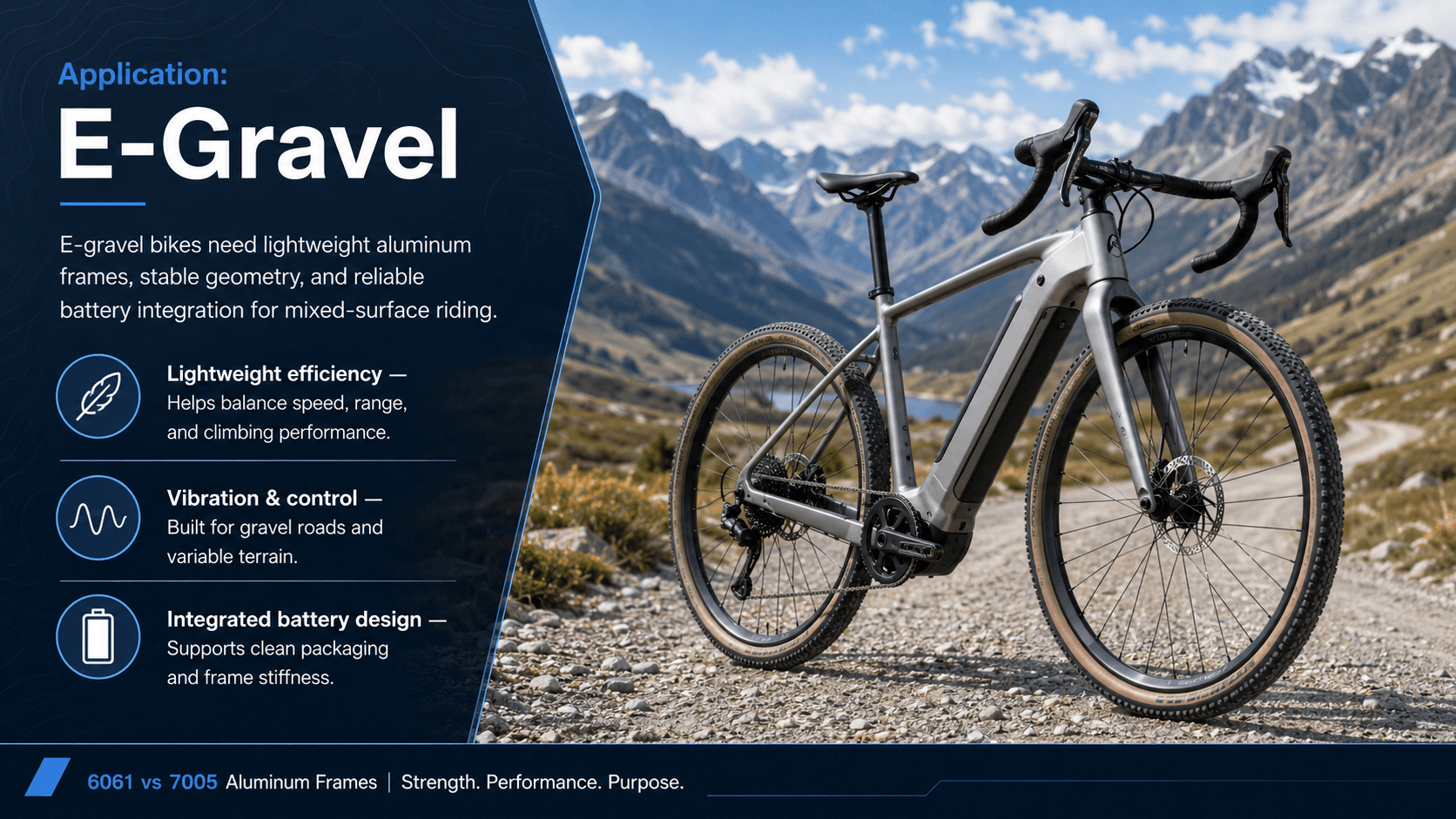
6061 vs 7005 Aluminum: Key Differences at a Glance
When bicycle brands compare 6061 vs 7005 aluminum, they often focus only on strength.
That is too simplistic.
A better comparison includes at least seven factors:
Raw material strength
Density
Tube design
Formability
Welding behavior
Heat treatment
Finished-frame fatigue performance
For e-bikes, several additional factors become important:
Motor torque
Battery integration
Frame weight
Suspension loads
Production consistency
Testing requirements
This is why an alloy comparison for a conventional road bicycle cannot simply be applied directly to a modern full suspension e-bike frame.
Is 7005 Aluminum Stronger Than 6061?
In terms of typical base-material mechanical properties, yes, 7005 generally has higher tensile and yield strength than 6061-T6.
Typical reference values are approximately:
Mechanical Property | 6061-T6 | 7005-T6 |
Ultimate Tensile Strength | 310 MPa | 350 MPa |
Yield Strength | 276 MPa | 290 MPa |
Elastic Modulus | Around 69 GPa | Around 72 GPa |
Based only on these numbers, it is tempting to declare 7005 the winner.
But bicycle frames are not solid laboratory test bars.
A real e-bike frame consists of:
Thin-wall tubes
Welded joints
Heat-affected zones
Forged parts
CNC-machined parts
Motor interfaces
Battery openings
Pivot structures
Suspension mounts
Stress is not distributed evenly across these components.
In many real frames, failures are more likely to begin near high-stress areas such as weld transitions, motor mounts, pivots, shock mounts, head tubes, or battery openings than in the middle of an undisturbed tube.
Therefore, finished-frame engineering matters more than comparing two raw tensile-strength numbers.
Does 7005 Make a Lighter E-Bike Frame?
Not necessarily.
Because 7005 has higher base-material strength, engineers may be able to use thinner walls in selected sections.
In theory, this can reduce weight.
However, 7005 is also slightly denser than 6061.
More importantly, an actual frame's weight is determined by:
Tube diameter
Tube wall thickness
Butting
Hydroforming
Reinforcement
Motor mount structure
Battery cavity design
Suspension layout
Forged components
Dropouts
Pivot hardware
For an e-bike, the extra structural demands created by the motor and battery also reduce the importance of small differences in alloy density.
A well-optimized 6061 frame may therefore be lighter than a conservative 7005 design.
Likewise, a well-engineered 7005 frame may be lighter than an overbuilt 6061 frame.
Alloy grade alone cannot predict finished frame weight.
6061 vs 7005: Which Is Stiffer?
This is another commonly misunderstood question.
7005 has a slightly higher elastic modulus than 6061, but the difference is relatively small.
The stiffness of a finished bicycle frame depends much more heavily on:
Tube diameter
Tube profile
Wall thickness
Junction shape
Down tube dimensions
Chainstay geometry
Seatstay geometry
Motor mount design
Suspension architecture
Increasing tube diameter can dramatically change bending stiffness even when the alloy remains exactly the same.
Therefore, claims such as:
"7005 always rides stiffer than 6061"
are an oversimplification.
Engineers can make a very stiff 6061 frame or a more compliant 7005 frame by changing tube geometry.
For an e-bike brand, the better question is:
Has the frame structure been engineered for the desired stiffness, strength, weight, and ride characteristics?
How Welding Changes the 6061 vs 7005 Comparison
Welding is one of the most important differences between these two materials.
Bicycle frames contain numerous welded joints, including:
Head tube to top tube
Head tube to down tube
Seat tube junctions
Chainstays
Seatstays
Motor mounts
Bottom bracket structures
Shock mounts
Suspension pivot structures
The heat created during welding changes the material properties around these joints.
That area is called the heat-affected zone, or HAZ.
What Happens to 6061 During Welding?
6061-T6 receives much of its strength from heat treatment.
When welding temperatures heat the area surrounding the joint, the original T6 properties are reduced locally.
This means a newly welded 6061 frame does not automatically retain the same properties as the original T6 tubing.
Professional manufacturing therefore uses a controlled post-weld process to restore the required material condition.
Depending on the manufacturing specification, this can involve:
Solution heat treatment
Controlled quenching
Artificial aging
Alignment correction
Dimensional inspection
The process must be carefully controlled.
Poor heat treatment or inadequate alignment after heat treatment can compromise an otherwise good frame design.
What Happens to 7005 During Welding?
7005 behaves differently.
Its metallurgy allows manufacturers to use different post-weld aging strategies and restore substantial strength without necessarily following exactly the same full solution-treatment route used with 6061.
This is one reason 7005 has historically been attractive to some aluminum frame builders.
However, saying that:
"7005 requires no heat treatment"
is also too simplistic.
The exact procedure depends on:
Initial temper
Tube condition
Filler material
Welding procedure
Required final mechanical properties
Manufacturer's production specification
Professional frame manufacturing should always follow a validated welding and aging process rather than relying on the assumption that a particular alloy automatically solves post-weld strength issues.
Why the Heat-Affected Zone Matters
A frame is only as reliable as its critical structural areas.
Even if the base tubing has excellent mechanical strength, inappropriate welding can create a weak region near the joint.
This is especially important for e-bikes because stress can concentrate around:
Motor mounts
Bottom brackets
Suspension pivots
Shock mounts
Head tubes
Battery openings
Chainstay junctions
For this reason, a professional OEM buyer should ask more than:
"Do you use 6061 or 7005?"
A much better question is:
"How do you control welding, heat treatment, alignment and fatigue validation after welding?"
Heat Treatment: One of the Biggest Differences
Heat treatment deserves special attention because it separates professional frame manufacturing from basic aluminum fabrication.
For a high-quality 6061 e-bike frame, controlled heat treatment helps restore mechanical properties reduced during welding.
But heating and cooling a complete welded frame can also introduce distortion.
Manufacturers therefore need proper:
Heat-treatment equipment
Fixtures
Alignment procedures
Dimensional inspection
Process control
The ability to heat-treat a frame correctly is therefore not a disadvantage of 6061.
When the process is properly controlled, it allows manufacturers to achieve consistent performance across production batches.
For large-scale OEM and ODM e-bike manufacturing, process repeatability is critical.
Why 6061 Is So Common in Modern E-Bike Frames
6061 is widely used because it solves multiple engineering and manufacturing problems at the same time.
1. Excellent Formability
Modern e-bike frames often require complex tube shapes.
Hydroforming and other tube-forming methods allow engineers to place material where it is needed rather than simply increasing wall thickness everywhere.
This helps improve:
Strength
Stiffness
Weight distribution
Appearance
Battery integration
6061 is well suited to these manufacturing processes.
2. Good Weldability
Modern frames contain many structural welds.
6061 provides predictable welding characteristics when proper procedures are followed.
3. Strong Supply Chain
6061 tubing, forgings, extrusions, and machined stock are widely available.
This can simplify sourcing and production planning for OEM programs.
4. Good Corrosion Resistance
E-bikes may be used in:
Rain
Mud
Humid conditions
Coastal environments
Winter conditions
Proper surface treatment combined with 6061's corrosion resistance makes it practical for global markets.
5. Good Balance of Cost and Performance
6061 is neither a low-performance material nor an exotic premium material.
Instead, it offers a highly practical engineering balance.
For mass-produced and premium aluminum e-bikes alike, this balance can be extremely valuable.
When Does 7005 Make Sense for a Bike Frame?
7005 remains an excellent bicycle-frame material.
It can make sense when:
Higher base-material strength is useful
Thin-wall tubing is available
The manufacturer has experience processing 7005
The frame design benefits from the alloy
The supply chain supports the required tube profiles
The production volume supports the material strategy
The post-weld process has been properly validated
Some performance-oriented bicycle designs have successfully used 7005 for many years.
The key point is not that 6061 is "good" and 7005 is "bad," or vice versa.
They are simply different engineering tools.
Why E-Bikes Put More Demands on an Aluminum Frame
Material selection becomes more complex for e-bikes because an electric bicycle is not simply a conventional bicycle with a motor attached.
Motor, battery, suspension, and higher system weight all affect frame loading.
Motor Torque and Motor Mount Loads
A mid-drive motor transfers torque through an area close to the bottom bracket.
This means engineers must consider:
Motor mount stiffness
Torsional loads
Chain forces
Weld placement
Local reinforcement
Clearance
Motor removal and service
A strong alloy alone cannot solve a poorly designed motor mount.
The geometry and load path around the motor are critical.
Battery Weight and Downtube Design
Modern batteries can add several kilograms to the bicycle.
Many premium e-bikes integrate the battery inside the downtube.
That creates another engineering challenge.
The downtube must be large enough to accommodate the battery while maintaining sufficient:
Torsional stiffness
Bending stiffness
Local strength
Impact resistance
A battery opening may also reduce the continuity of the tube structure.
Engineers must compensate through tube shaping, reinforcement, wall-thickness optimization, or structural design.
Again, this problem cannot be solved by choosing 7005 instead of 6061.
It requires proper frame engineering.
Full-Suspension E-MTB Loads
A full suspension e-MTB frame experiences complicated loading.
The frame must handle forces from:
Motor torque
Pedaling
Landing impacts
Rear-wheel impacts
Suspension compression
Braking
Cornering
Rider weight
Suspension pivots and shock mounts create highly concentrated load paths.
For this reason, factors such as:
Pivot positioning
Bearing interfaces
Shock mount geometry
Forged components
Weld locations
Tube shapes
may be more important than the small difference in raw alloy strength.
Braking, Rider Weight and Impact Loads
E-bikes are often heavier and may operate under higher loads than conventional bicycles.
That means frames must withstand repeated:
Braking loads
Vertical loads
Pedaling forces
Impacts
Vibration cycles
Engineering validation and fatigue testing therefore become essential.
An alloy name printed on a specification sheet cannot replace testing.
6061 vs 7005 for Different E-Bike Applications
Different applications create different engineering priorities.
E-Bike Type | 6061 | 7005 | Key Requirement |
E-City Bike | Excellent choice | Suitable | Cost, reliability, battery integration |
E-Gravel | Excellent choice | Suitable | Weight, stiffness, tube shaping |
Hardtail E-MTB | Excellent choice | Excellent choice | Impact and torsional strength |
Full Suspension E-MTB | Excellent choice | Excellent choice | Suspension loads and motor integration |
Cargo E-Bike | Excellent choice | Suitable | High load capacity and durability |
Trekking E-Bike | Excellent choice | Suitable | Reliability and manufacturing efficiency |
In every category, either alloy can work when properly engineered.
For most high-volume modern e-bike programs, however, 6061 offers an especially attractive combination of performance and manufacturing flexibility.
Why Frame Design Matters More Than the Alloy Number
Imagine two frames.
Frame A uses 7005 but has:
Poor weld placement
Sharp stress transitions
Inadequate motor reinforcement
Thin material around the battery opening
Poor suspension pivot design
Frame B uses 6061 but has:
Optimized tube profiles
Controlled welding
Proper heat treatment
Reinforced motor mounts
Smooth load transitions
Validated fatigue performance
Which frame is better?
Very likely Frame B.
That illustrates one of the most important lessons in bicycle engineering:
Material selection cannot compensate for poor structural design.
The finished frame should be evaluated as a complete system.
What Should OEM and ODM E-Bike Brands Consider?
If you are sourcing frames for an e-bike brand, do not select a supplier based only on whether they advertise 6061 or 7005 aluminum.
Ask these following questions instead.
What Alloy and Temper Are Used?
"Aluminum" alone is not enough.
Ask for the exact material specification.
How Are the Tubes Formed?
Determine whether the manufacturer supports:
Hydroforming
Butting
CNC machining
Forging
Precision extrusion
How Is Welding Controlled?
Ask about:
Welding procedures
Weld consistency
Fixtures
Inspection
Welder experience
What Happens After Welding?
For 6061 in particular, ask how the manufacturer controls:
Heat treatment
Aging
Alignment
Dimensional inspection
How Is the Motor Mount Designed?
For mid-drive e-bikes, the motor region is a major structural component.
Ask whether the manufacturer has experience with systems such as:
Bosch
Shimano
Bafang
Avinox
How Is the Frame Tested?
A professional frame program should use testing appropriate to the intended bicycle category and target market.
Frame evaluation may include:
Pedaling fatigue tests
Horizontal fatigue tests
Vertical fatigue tests
Disc brake fatigue tests
Impact tests
Drop tests
Testing provides much more meaningful information than simply comparing alloy datasheets.
BROVA Engineering Perspective: Why We Use 6061 Aluminum
At BROVA, many of our aluminum bicycle and e-bike frame platforms use 6061 aluminum.
The decision is not based on material price alone.
For modern e-bike development, 6061 gives our engineering team the flexibility required to combine structural performance with complex frame integration.
Our e-bike frame portfolio includes platforms engineered for drive systems such as:
Bosch
Shimano EP801
Bafang
Avinox
These projects may require:
Integrated motor mounts
Internal battery packaging
Complex downtube profiles
Full-suspension structures
CNC-machined interfaces
Precision pivot locations
Internal cable routing
Custom frame geometry
6061 provides a strong manufacturing foundation for these requirements when combined with controlled welding, heat treatment, alignment, machining, and testing.
For example, a modern full suspension E-MTB frame must do far more than achieve a particular tensile-strength number.
The complete frame must balance:
Motor clearance
Battery capacity
Suspension kinematics
Tire clearance
Frame stiffness
Weight
Strength
Manufacturing repeatability
This is why we evaluate material as one part of the complete frame-engineering process rather than treating the alloy number as a marketing specification.
How to Evaluate a 6061 or 7005 E-Bike Frame
If you are comparing two frame suppliers, consider the following checklist.
Material
Is the exact alloy specified?
Is the material traceable?
Is the temper controlled?
Engineering
Has the frame been designed for the intended motor?
Is battery integration structurally considered?
Are critical areas reinforced appropriately?
Is suspension geometry validated?
Manufacturing
Are tube profiles properly controlled?
Are CNC interfaces accurate?
Are welding procedures consistent?
Is post-weld processing controlled?
Quality Control
Is frame alignment inspected?
Are welds inspected?
Are critical dimensions checked?
Testing
Has the frame undergone fatigue testing?
Has it undergone impact testing?
Is testing appropriate for the intended bicycle category?
When these factors are considered together, buyers obtain a much more realistic picture of frame quality.
6061 vs 7005: Which Is Better for E-Bikes?
There is no universal winner.
Choose 6061 when you prioritize:
Excellent manufacturing versatility
Complex hydroformed shapes
Integrated battery design
Good weldability
Reliable material availability
Consistent large-scale production
Strong cost-to-performance balance
Consider 7005 when you prioritize:
Higher base-material strength
Specific thin-wall designs
A production process already optimized for 7005
Performance applications where its properties provide a meaningful engineering advantage
For electric bicycles nowadays, especially integrated aluminum e-bike frames and full suspension E-MTB frames, 6061 is an extremely effective material.
But the final decision should always be made at the frame-system level.
A well-engineered 6061 e-bike frame is better than a poorly engineered 7005 frame, and a well-engineered 7005 frame is better than a poorly engineered 6061 frame.
The engineering matters more than the alloy label.
Frequently Asked Questions
Is 7005 aluminum stronger than 6061?
Generally, yes.
Typical 7005-T6 base-material data show somewhat higher tensile and yield strength than 6061-T6.
However, this does not automatically mean that a finished 7005 bicycle frame is stronger than a 6061 frame. Tube geometry, wall thickness, welding, heat treatment and structural design all influence actual frame performance.
Is 7005 aluminum lighter than 6061?
Not inherently.
7005 is actually slightly denser than 6061.
Because 7005 has higher material strength, engineers may sometimes use thinner tube walls, potentially reducing finished frame weight.
Whether the final frame is lighter depends on the complete design.
Is 6061 aluminum good for e-bike frames?
Yes.
6061 aluminum is an excellent material for e-bike frames because it combines strength, weldability, corrosion resistance, formability and manufacturing flexibility.
It is particularly suitable for modern frames requiring integrated batteries, mid-drive motor mounts and complex hydroformed tubing.
Is 6061 aluminum suitable for full suspension E-MTB frames?
Yes.
6061 is widely suitable for demanding full suspension frame structures when the frame is correctly engineered, welded, heat-treated and tested.
The success of a full suspension E-MTB frame depends on suspension loads, motor integration, pivot locations, tube geometry and fatigue performance—not simply alloy grade.
Does 6061 need heat treatment after welding?
Welding reduces the local properties of 6061-T6 around the heat-affected zone.
Professional frame manufacturing therefore uses controlled post-weld processing to achieve the required final mechanical properties.
The exact heat-treatment specification should be defined by the manufacturer and engineering requirements.
Does 7005 need heat treatment after welding?
7005 can use different post-weld aging approaches from 6061, and its metallurgy can make it possible to recover significant strength without exactly the same solution-treatment process commonly associated with 6061.
However, it is misleading to say that 7005 simply requires "no heat treatment."
The correct process depends on alloy temper, welding procedure and required final properties.
Which is more durable, 6061 or 7005?
There is no reliable answer based on alloy number alone.
The durability of a bicycle frame depends heavily on:
Frame geometry
Tube thickness
Welding quality
Heat treatment
Stress concentration
Rider and system loads
Fatigue testing
Both alloys can produce highly durable bicycle frames.
Which aluminum alloy is best for an E-MTB?
Both 6061 and 7005 can work extremely well.
6061 is particularly attractive for modern E-MTBs because it works well with complex tube shaping, motor integration, battery packaging, CNC components and large-scale production.
The best alloy is the one that matches the complete engineering and manufacturing strategy.
Can 6061 aluminum handle mid-drive motor torque?
Yes, when the frame is correctly engineered.
Motor torque is not handled by the alloy alone. The motor mount, downtube, seat tube, bottom bracket area, weld placement and reinforcement strategy must work together to distribute loads safely.
Is alloy strength the most important factor when choosing an e-bike frame?
No.
Base-material strength matters, but the complete frame design matters more.
OEM buyers should evaluate engineering, tube shaping, welding, heat treatment, quality control, motor integration, battery integration and frame testing before selecting a supplier.
Final Thoughts
The debate over 6061 vs 7005 aluminum bike frames often focuses too heavily on one question:
Which alloy is stronger?
7005 generally wins that comparison on raw base-material strength.
But e-bike engineering requires a much broader perspective.
A modern electric bicycle frame must integrate the motor, battery, suspension, rider loads, braking forces and manufacturing requirements into one structural system.
For these reasons, 6061 continues to be an excellent choice for many modern e-bike platforms.
Its combination of strength, weldability, formability, corrosion resistance, supply-chain availability and manufacturing versatility allows engineers to build sophisticated aluminum frames for applications ranging from E-City and E-Gravel bikes to high-performance full suspension E-MTBs.
For bicycle brands, the better purchasing question is therefore not simply:
"Is 6061 or 7005 better?"
Instead, ask:
"Which material and manufacturing process allow this particular frame design to achieve the required strength, weight, durability, integration and production consistency?"
That is the question that ultimately determines whether an e-bike frame performs successfully in the real world.
Looking for a Custom Aluminum E-Bike Frame?
BROVA provides engineering-driven aluminum bicycle and e-bike frame solutions for global bicycle brands.
Our capabilities cover frame development for applications including:
Full Suspension E-MTB Frames
Hardtail E-MTB Frames
E-City Frames
E-Gravel Frames
Custom Aluminum Bike Frames
OEM E-Bike Frames
ODM E-Bike Frame Platforms
We support frame development around leading drive systems including Bosch, Shimano, Bafang and Avinox.
From frame geometry and motor integration to prototyping, manufacturing and testing, our goal is to help bicycle brands develop production-ready aluminum frame platforms.
Have an e-bike frame project in development? You are more than welcomed to contact the BROVA engineering team to discuss your geometry, motor system, battery requirements and production targets.
Related Blogs
-
 An aluminum bicycle frame brings material selection, tube design, joint engineering, and manufacturing control together. Its performance mainly depends on how these elements working with each other under pedaling, braking, impacts, and repeated loading.For bicycle brands and product developers, choo
 -
 If you are developing an aluminum e-bike frame, two alloy names appear again and again: 6061 aluminum and 7005 aluminum.At first glance, choosing between them seems simple. 7005 has higher raw tensile strength, while 6061 is widely used throughout the bicycle industry. That often leads to a basic qu
 -
 IntroductionThe bicycle industry is changing faster than ever.From traditional mountain bikes and road bikes to high-performance electric mountain bikes (e-MTBs), bike manufacturers all over the world are constantly developing new technologies for the purpose of riding performance improvement, durab
