


An aluminum bicycle frame brings material selection, tube design, joint engineering, and manufacturing control together. Its performance mainly depends on how these elements working with each other under pedaling, braking, impacts, and repeated loading.
For bicycle brands and product developers, choosing an alloy is only the beginning. A successful frame has to accommodate components, maintain alignment through manufacturing, and deliver consistent performance across production batches.
This guide explains the key decisions behind aluminum bicycle frame design and welding, with practical considerations for mountain bikes, full-suspension frames, and electric bicycles.
What Makes a Good Aluminum Bicycle Frame?
A good aluminum bicycle frame balances weight, stiffness, strength, durability, and manufacturability for a defined riding application.
These qualities are related, but they describe different requirements:
Strength: The ability to withstand loads without yielding or breaking.
Stiffness: The resistance to bending or twisting under load.
Fatigue performance: The ability to withstand repeated loading over time.
Weight: The mass required to achieve the intended structural performance.
Manufacturability: The ability to produce the design consistently within specified tolerances.
Increasing material strength does not automatically make a frame stiffer. Likewise, reducing tube thickness may lower weight while making welding, dent resistance, and fatigue performance more difficult to manage.
The design objective is to achieve the required performance with a structure that can be manufactured and verified reliably.
Start With the Intended Riding Application
Before selecting tubing or developing weld details, define how the bicycle will be used.
A city commuter, a trail bike, and a cargo e-bike place different demands on their frames. Even frames with similar appearances may require different tube sections, reinforcement strategies, and validation plans.
A useful design brief should specify:
Design input | Why it matters |
Bicycle category and intended terrain | Establishes relevant loading conditions |
Maximum permitted system mass | Defines the combined bicycle, rider, and cargo load |
Frame sizes and geometry | Influences tube lengths, leverage, fit, and handling |
Wheel and tire dimensions | Determines clearance and packaging requirements |
Fork length and suspension travel | Affects geometry and loading around the head tube |
Brake and axle interfaces | Defines local mounting and alignment requirements |
Motor and battery configuration | Establishes structural and service requirements for e-bikes |
Target markets and test requirements | Guides the validation program |
Production volume and target cost | Influences tooling and manufacturing choices |
Resolve these inputs before optimizing frame weight, otherwise late changes to components or load requirements can force substantial redesign.
Choosing Aluminum for Bicycle Frames
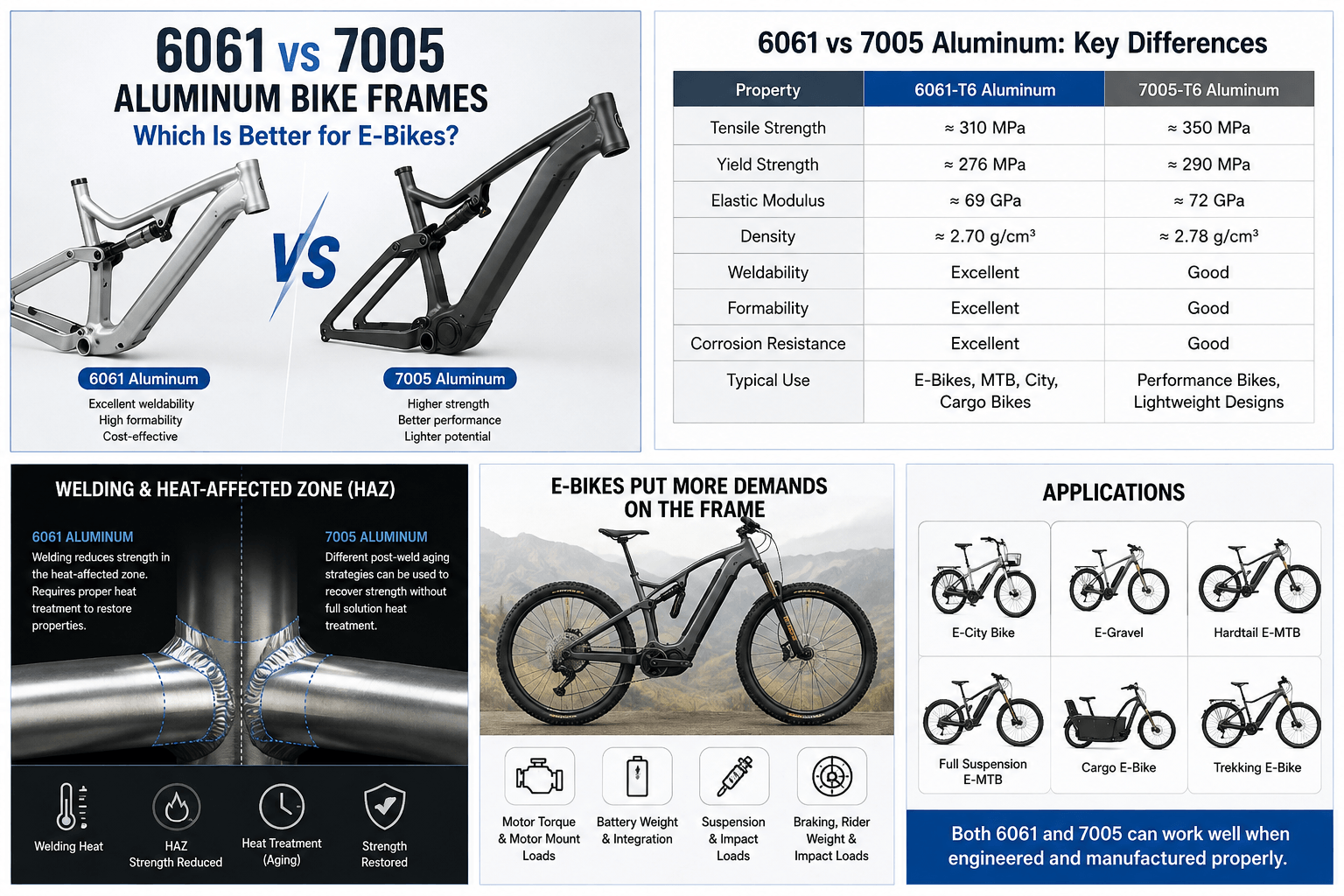
6061 Aluminum
6061 is a heat-treatable aluminum alloy containing magnesium and silicon. Its combination of weldability, mechanical properties, and processing versatility makes it relevant to structural components.
However, welding changes the strength of material supplied in a heat-treated condition. The properties of incoming 6061-T6 tubing should then not be assumed to represent the properties of every region in a finished welded frame. Appropriate heat treatment can restore strength, but the manufacturing route must be controlled and verified. Source: Hydro’s 6061 aluminum overview.
For a frame development project, specify both the incoming material condition and the required properties after manufacturing.
Evaluating Alternative Alloys
When considering an alternative such as 7005, compare the complete manufacturing route with the tubing supplier and frame manufacturer.
Ask for documented information covering:
Available tube dimensions and material conditions.
Forming limitations.
Compatible filler metals.
Post-weld processing requirements.
Verified properties in the finished condition.
Relevant prototype and production experience.
Avoid selecting an alloy solely from a table of nominal tensile strengths. The actual frame includes welded joints, formed sections, holes, interfaces, and manufacturing variations which material datasheets alone cannot represent.
Aluminum Bicycle Frame Geometry and Component Compatibility
Frame geometry establishes rider position and influences handling. Structural design determines how the frame carries loads within that geometry.
Develop both together.
Define Geometry as a Complete System
Important dimensions include reach, stack, head tube angle, seat tube angle, chainstay length, wheelbase, and bottom bracket position.
For suspension bicycles, also consider how geometry changes with sag and suspension movement. A design reviewed only at full extension may miss clearance or packaging problems elsewhere in the travel.
Confirm Interfaces Before Finalizing Tubes
Create an interface drawing that identifies:
Headset and fork compatibility.
Bottom bracket or motor mounting details.
Rear axle spacing and attachment.
Brake mounting geometry.
Seatpost diameter and insertion depth.
Tire and chainring clearance.
Shock dimensions and mounting hardware.
Cable, hose, and electrical routing.
For an e-bike, use the component supplier’s interface specifications for the exact motor and battery models. Compatibility with one product does not establish compatibility with every product from the same brand.
Tube Diameter, Wall Thickness, and Shape
Tube design allows engineers to distribute material according to structural needs.
Tube Diameter and Cross-Section
Changing a tube’s diameter or cross-section changes its resistance to bending and twisting. A larger section can improve stiffness efficiently, but packaging, local buckling, damage resistance, and joint design constrain how thin its walls can become.
Assess each tube in relation to its load paths. The down tube, seat tube, and chainstays perform different structural and packaging roles.
Butted Tubing
Butted tubing uses different wall thicknesses along its length. Thicker sections can support joint regions, while thinner sections reduce mass elsewhere.
The position of each thickness transition matters. After cutting and mitering, the intended reinforced section must still be located correctly around the joint.
Drawings and inspection plans should identify these locations rather than specifying only an overall tube length.
Hydroformed Tubing
Hydroforming uses internal fluid pressure and tooling to shape tubing into more complex sections. It can support packaging requirements and allow designers to vary tube geometry along its length. Bicycle manufacturers use it to create shapes that would be difficult to achieve with simple straight tubing.
A hydroformed shape still requires engineering validation. Review local wall thickness after forming, transition radii, dimensional consistency, and welding access.
The benefit comes from a useful, controlled shape—not simply from a more complex appearance.
Joint Design: Where Frame Durability Takes Shape
A frame transfers loads through a network of tube junctions and component interfaces. These areas deserve particular attention during design reviews.
Head Tube Junction
The head tube connects steering and fork loads to the main frame.
Review the relationship between the top tube, down tube, and head tube, including:
Tube intersection geometry.
Local section changes.
Weld access around the joint.
Cable openings near highly loaded regions.
Any reinforcement and its termination points.
A reinforcement should distribute load progressively. An abrupt end can move a stress concentration to another location.
Bottom Bracket and Motor Mounts
The bottom bracket region connects the main frame to the drivetrain and rear triangle. On a mid-drive e-bike, the motor interface adds mounting, clearance, and service requirements.
Check fastener access, chainline, crank clearance, and dimensional accuracy alongside structural performance.
Increasing material thickness alone may not solve a problem caused by poor load transfer or unfavorable joint geometry.
Suspension Pivots and Shock Mounts
Full-suspension aluminum frames require precise relationships between pivot axes, bearing seats, and shock mounts.
Review the assembly throughout its travel and account for tolerances, deflection, and service access.
A pivot arrangement that fits correctly in CAD can still bind if welding distortion or bearing-seat variation is not controlled in production.
Why Aluminum Frame Welding Requires Careful Control
Aluminum presents several welding challenges. It conducts heat rapidly, carries a surface oxide layer, and can develop porosity when hydrogen becomes trapped during solidification. These characteristics make preparation, shielding, and process control essential. Source: TWI’s aluminum welding guide.
A visually uniform weld bead is useful, but appearance alone cannot establish joint integrity.
The welding process must produce acceptable fusion and geometry while controlling distortion and the effects of heat on surrounding material.
TIG Welding for Aluminum Bicycle Frames
Tungsten inert gas welding, also called gas tungsten arc welding, allows controlled application of heat and filler metal. It can be used to join thin aluminum sections, making it relevant to bicycle frame fabrication. Source: TWI’s aluminum welding guide.
For production, the important question is whether the selected process can repeatedly meet the joint requirements.
Establish a Documented Welding Procedure
A welding procedure should define the variables needed for consistent results, including:
Base alloys and material conditions.
Joint preparation and permitted fit-up variation.
Filler classification and size.
Shielding gas requirements.
Welding parameters and technique.
Welding sequence.
Temperature controls where applicable.
Inspection and acceptance criteria.
There is no universal welding setting for an aluminum bicycle frame. Thin stays, larger main tubes, and thicker machined interfaces create different thermal conditions.
Validate representative joints before applying the procedure to production frames.
Preparing Aluminum Tubes for Welding
Accurate Cutting and Fit-Up
Tube ends should match the intended joint geometry without excessive gaps or forced alignment.
Poor fit-up can require additional filler and heat, making the joint more difficult to control. For butted tubing, preparation must also preserve the intended wall thickness around the weld.
Check the prepared parts against the drawing before assembly.
Cleaning the Joint
Remove oil and other contamination before addressing the oxide layer. Miller recommends cleaning aluminum and then brushing it with a stainless steel wire brush before assembling the joint. Any cleaning solvent must evaporate completely before welding.
Use tools dedicated to aluminum and handle prepared parts in a way that limits recontamination.
Include filler storage and handling in the preparation process. Clean base material cannot compensate for contaminated consumables.
Fixturing and Tack Welding
Fixtures should locate the frame from defined datums and support a repeatable assembly sequence.
They must also provide sufficient torch access. A fixture that holds every component securely but prevents consistent welding around a critical joint creates another manufacturing problem.
Check alignment after tack welding so that errors can be addressed before completing the welds.
Selecting Filler Metal
Filler selection depends on the base alloys, required joint properties, finishing process, and subsequent thermal treatment.
4043 and 5356 are familiar aluminum filler classifications, but they are not universally interchangeable. Compatibility and performance requirements should guide the choice. Source: ESAB’s aluminum filler selection guide.
For bicycle frames, confirm the filler against the complete alloy combination at each joint. A machined component may use a different alloy from the adjoining tube.
Document the approved filler in the welding procedure and control substitutions through engineering review.
The Heat-Affected Zone and Post-Weld Heat Treatment
What Is the Heat-Affected Zone?
The heat-affected zone, or HAZ, is the region beside a weld that does not melt but experiences changes in material properties because of the welding heat. Its characteristics depend on the material and thermal cycle. Source: TWI’s explanation of the heat-affected zone.
This is why frame evaluation must consider more than the weld bead itself.
Why the Finished Material Condition Matters
For heat-treated 6061, welding can reduce strength near the joint. ESAB identifies the relationship between welding heat input and the mechanical properties of the adjacent material. Source: ESAB on welding 6061-T6.
A manufacturing plan should therefore identify:
The required final material condition.
The approved post-weld thermal process.
Dimensional checks after processing.
The method used to verify resulting properties.
Do not assume that a paint-curing oven provides the required structural heat treatment. Finishing and heat treatment serve different purposes and must be evaluated together.
Controlling Frame Distortion and Alignment
Welding and subsequent thermal processing can change frame dimensions.
Control should begin with joint preparation and continue through fixturing, welding sequence, heat treatment, and final inspection.
Useful checkpoints include:
Component dimensions before assembly.
Geometry after tack welding.
Alignment after welding.
Dimensions after thermal processing.
Finished interfaces after machining and coating.
Inspect relationships that affect assembly and function, including the head tube, rear axle, bottom bracket or motor mounts, and suspension pivots.
Where final machining is required, include sufficient material and access in the original design.
Common Aluminum Frame Welding Defects
Issue | Why it matters | Areas to investigate |
Porosity | Can reduce joint mechanical performance | Cleanliness, moisture, consumables, and shielding |
Lack of fusion | Leaves an inadequately bonded region | Joint access, preparation, oxide removal, and technique |
Undercut | Reduces the local section and creates a notch | Parameters, travel speed, and weld profile |
Cracking | Compromises structural integrity | Alloy compatibility, restraint, filler, and procedure |
Distortion | Changes alignment and component fit | Fit-up, fixturing, sequence, and thermal processing |
Porosity can affect ductility, strength, and fatigue behavior, depending on its extent and the loading conditions. This makes defect control a structural concern as well as a cosmetic one. Source: TWI on porosity and aluminum weld properties.
Any repair or rework procedure should have defined acceptance criteria. Cosmetic blending should not remove structural material without engineering approval.
Additional Design Considerations for Aluminum E-Bike Frames
E-bike development adds component integration and service requirements to the frame design process.
Battery Openings
An integrated battery can require a substantial opening in the down tube. Evaluate how that opening changes the section and transfers loads around its edges.
Check corner radii, local reinforcement, battery retention, cover attachment, drainage, and access for removal.
Motor Integration
Review the motor mount with the exact drive unit and hardware.
The design should account for mounting loads, fastener access, cable protection, chainline, and the ability to remove the motor for service.
Suspension and Cable Movement
On a full-suspension e-bike, check hoses and electrical cables throughout the complete travel range.
Allow for tolerances and movement so that routing does not become pinched, stretched, or abraded during use.
Testing and Quality Control Before Production
A complete validation plan should combine material verification, dimensional inspection, weld assessment, and physical testing.
Material and Process Records
Maintain traceability for tube batches, machined components, filler materials, and relevant thermal processing.
Records help determine whether a production batch matches the materials and process used for approved prototypes.
Inspection and Physical Testing
Visual inspection identifies accessible surface defects and workmanship issues. Additional examination methods may be needed for particular joints or development risks.
Select methods according to what they can detect. Surface inspection does not establish the absence of internal defects, and hardness measurements alone do not establish fatigue performance.
ISO 4210-6:2023 addresses bicycle frame and fork test methods in support of ISO 4210-2 requirements. Establish applicability for the intended bicycle category and market, especially for electric or specialized bicycles. Source: ISO’s bicycle standards listing.
The validation plan should identify which frame sizes, configurations, and component combinations are represented by the tested samples. Changes to tubing, weld details, or manufacturing processes should trigger a review of whether further validation is needed.
What to Ask an Aluminum Bicycle Frame Manufacturer
Before requesting production pricing, provide a clear technical brief and ask the manufacturer to explain its proposed process.
Useful questions include:
Which alloy and tubing condition are proposed?
How are tube thicknesses and formed sections controlled?
How are welding procedures established and maintained?
What happens to the frame after welding?
Which alignment dimensions are inspected?
How are motor mounts and suspension interfaces verified?
Which physical tests will be performed?
How are production changes and repairs controlled?
What records connect a finished frame to its material and process history?
A useful quotation should identify what is included in development, tooling, sampling, testing, finishing, and production.
Clear requirements make supplier comparisons more meaningful and reduce misunderstandings after prototype approval.
Frequently Asked Questions
Is 6061 Aluminum Suitable for Bicycle Frames?
Yes, it can be suitable when the frame design and manufacturing process account for its properties. Particular attention is needed around welded joints and the final material condition.
Does a Larger Weld Mean a Stronger Frame?
Weld size is only one variable. Fusion, joint geometry, surrounding wall thickness, defects, and thermal effects also influence performance. The appropriate weld should follow the engineered joint requirements.
Is There a Standard Wall Thickness for Aluminum Bicycle Frames?
No single thickness suits every frame. Requirements vary with tube dimensions, frame size, intended loads, joint details, and the manufacturing process. Different regions of one frame may need different thicknesses.
Does Hydroforming Guarantee a Lighter Frame?
No. Hydroforming provides shape flexibility. Weight savings depend on whether that flexibility produces a more efficient structure while preserving the required performance.
Can a Cracked Aluminum Bicycle Frame Be Rewelded?
A crack requires assessment of the frame’s material, damage, loading history, and original manufacturing process. Welding over it does not establish that the structure is safe. Stop riding the damaged frame and consult the manufacturer or a qualified specialist.
What Should Brands Prioritize During Frame Development?
Define the intended use, component interfaces, load requirements, and validation plan first. Then develop tubing and joints around a manufacturing process that can consistently meet those requirements.
Related Blogs
-
 An aluminum bicycle frame brings material selection, tube design, joint engineering, and manufacturing control together. Its performance mainly depends on how these elements working with each other under pedaling, braking, impacts, and repeated loading.For bicycle brands and product developers, choo
 -
 If you are developing an aluminum e-bike frame, two alloy names appear again and again: 6061 aluminum and 7005 aluminum.At first glance, choosing between them seems simple. 7005 has higher raw tensile strength, while 6061 is widely used throughout the bicycle industry. That often leads to a basic qu
 -
 IntroductionThe bicycle industry is changing faster than ever.From traditional mountain bikes and road bikes to high-performance electric mountain bikes (e-MTBs), bike manufacturers all over the world are constantly developing new technologies for the purpose of riding performance improvement, durab
